Now let’s cook
Tvorog makes up 500 g of the 771 g of dough, and nothing else comes close.
Ingredients
- 500 g tvoroga fresh white curd cheese, made by souring milk and draining off the whey
- 2 eggslarge hen’s egg, about 50 g without the shell
- 50 g sugarwhite granulated sugar
- 1 g saltfine table salt
- 120 g wheat flourground from wheat grains
- 3 tbsp vegetable oilmade from plant seeds or fruit
Method
Put 500 g of tvorog in a large bowl. If it has grains in it, rub it through a sieve.
Add 2 eggs, 50 g of sugar and 1 g of salt and mix until smooth. Add 120 g of flour and mix: the dough should be fairly thick. Do not taste the raw dough: it contains raw egg.
Wet your hands with water. Take about a tablespoon of dough, roll it into a ball and flatten it into a round. Shape the rest of the syrniki in the same way.
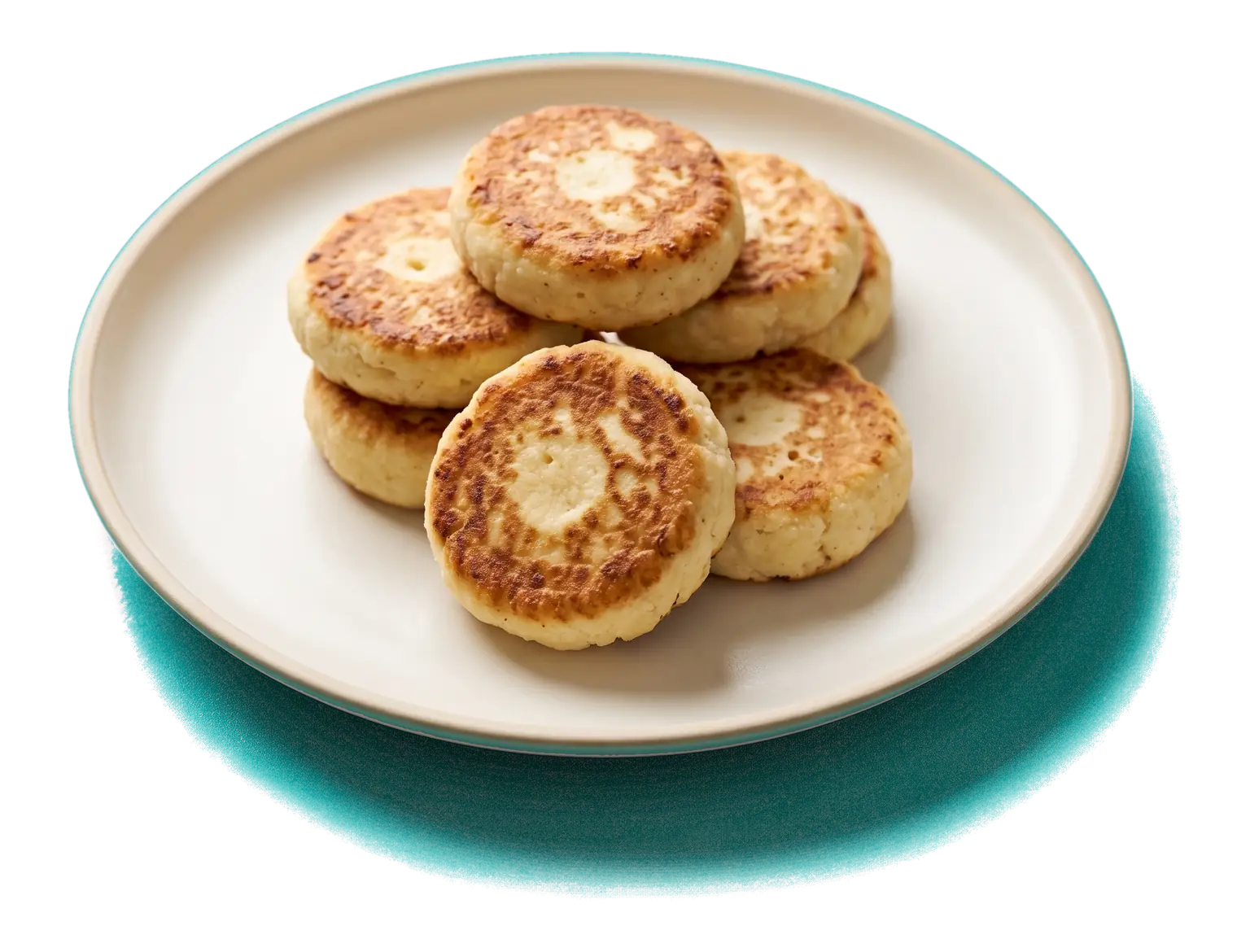
Heat a frying pan over a medium heat and grease it with 1 tbsp of vegetable oil. Put the syrniki in the pan in a single layer, in batches. Fry for 3–4 minutes, until a golden crust forms underneath. Turn them over, lower the heat a little and fry for about as long again: at least 74 °C in the middle of the thickest syrnik. Break open the thickest syrnik of the batch: if the middle is raw, put it back in the pan, fry the whole batch for longer and check again. Before the second and third batches, add another 1 tbsp of vegetable oil to the pan and do the same, checking the thickest syrnik of each batch. Move the cooked syrniki to a plate.
Where this dish comes from
Syrniki are fried rounds or small flat cakes made from a dough of tvorog and wheat flour. They are part of the Ukrainian, Belarusian and Russian cuisines. In Russia they are also called tvorozhniki. There is no single view on the origin of the name: one explanation links it to the Slavic word syr, which meant a soft curd cheese. Syrniki are traditionally served with sour cream or butter.